Studies of technoscientific worlds are always studies across disciplines and professions. While ‘interdisciplinarity’ has been a buzzword for many years, good methods for engaging across highly specialized differences remain a challenge. Co-laboration is a term coined by Jörg Niewöhner (e.g. 2015) to point to the collaborative and experimental work that goes into this. RUSTlab takes up the challenge by engaging with methods for technoscientific co-laborations. Contact us if you are interested in working together, either in research or teaching.
On this page we present example reflections on some of the co-laborations we practice and which you can find described under activities, and beyond.
Stakeholder Workshops
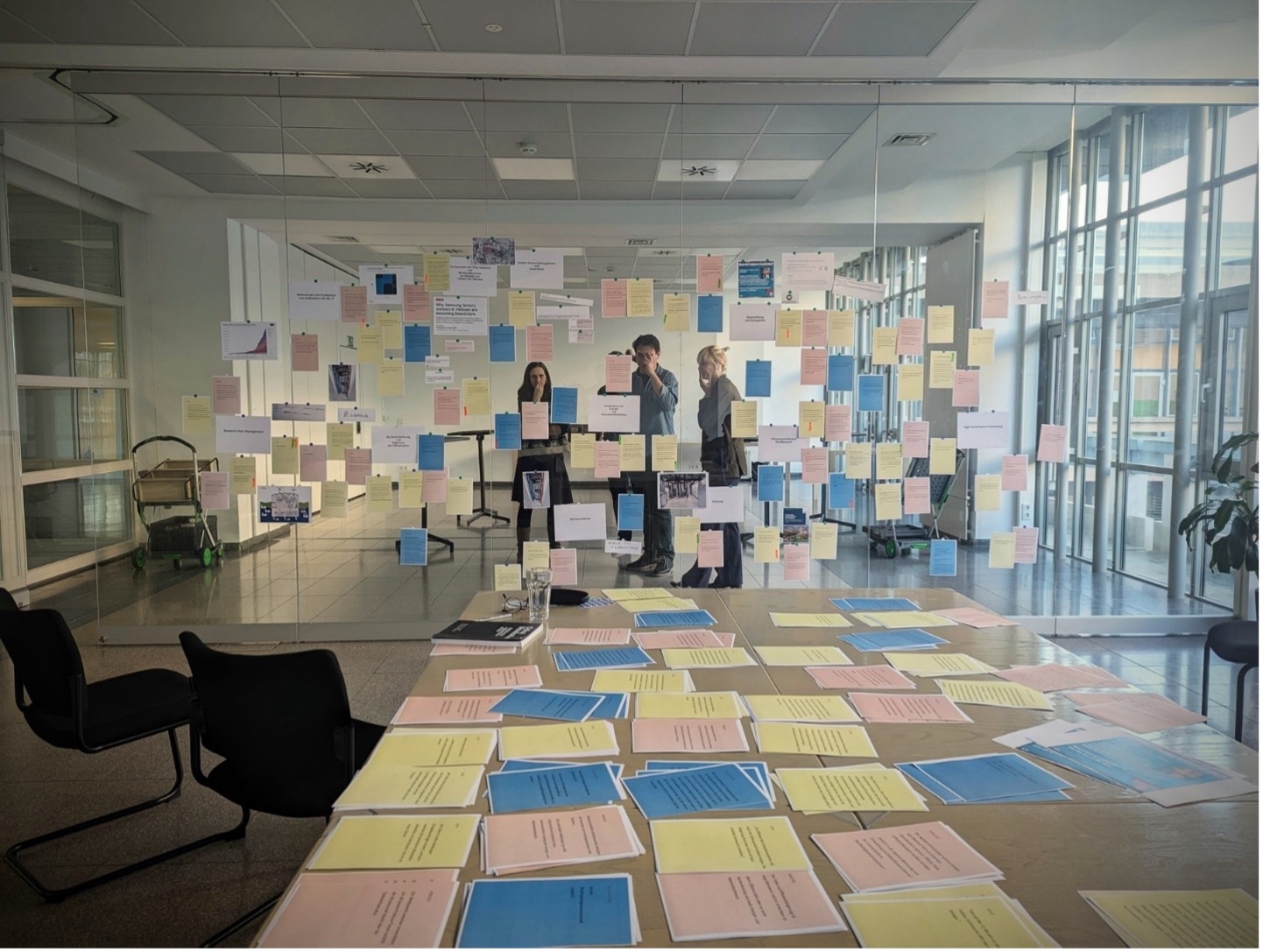
As part of our research, we conduct workshops with stakeholders. This is an integral part of our ethnographic method. For instance, nn November 2024, the project Virtual Information Infrastructures (as part of the CRC Virtual Lifeworlds) hosted a three-day mapping workshop at Ruhr-Universität Bochum bringing together the actors who build and use the university’s digital infrastructure: researchers, IT staff, administrators, and procurement officers. After two years of ethnographic fieldwork and around fifty interviews, the team presented first results and confronted participants with provocative theses, pinning interview fragments, analyses, and provocations onto a glass wall to create a shared, evolving map of perspectives. Graphic recording artists enriched the discussions in real time, and afternoons were spent with experts from Tantlab Copenhagen to sharpen the analytical interpretation. What emerged from these conversations was a detailed picture of the frictions and contradictions shaping sustainable data infrastructure at a research university: coordination gaps between technical and administrative expertise, the pull of scientific prestige and competition over sustainability concerns, the delegation of ecological responsibility to suppliers, and the structural separation between scientists who write code and infrastructure staff who run it. The question of who gets to know what about energy consumption turned out to be as much a political question as a technical one, a reminder that sustainable data practices require more than efficiency measures. Prep for this workshop was yet another event, hosted in Hanoi, discussing the expansion of the chip sector and how that relates to growing material interests.
Cybersecurity Workshop
RUSTlab organized a one-day event on interdisciplinarity in cybersecurity research accompanied by a keynote by Prof. Andrew Barry (UCL) on “What is an interdisciplinary problem?”. The workshop explored further directions in collaboration with the SecHuman PhD program. SecHuman investigates hetereogeneous aspects of cybersecurity and privacy. The program consists of 13 phd students from different disciplines (stretching across mathematics, computer science, humanities, social science, linguistics and psychology).
The PhD students were organized in tandems, two students working closely together in each tandem. The workshop reflected upon the interdisciplinary process since the initialization of the project (in 2017) and map out directions ahead. We did so by introducing two hands-on exercises; firstly, we used published articles from all participants to visualize a web of semantic relations between the texts. We asked the participants to interpret the web and speculate on the connections or partial connections between the areas of research in SecHuman. Secondly, we asked the participants to discuss a scenario and draw ways of action. They did so in groups of 5, randomly brought together. This scenario-based exercise brought to light technical and non-technical problematizations when attempting to introduce a new data storage system for a project team. The workshop ended in an open discussion of possible ways ahead and an evaluation of the hands-on exercise methodologies.